You can identify a broody hen fast if she stops laying, stays glued to one nest spot, and won’t leave even when the nest is empty. She’ll puff up, hiss, peck, or growl when you reach near her, and she may flatten over eggs like she’s guarding them. You might also notice reduced eating, quick returns after brief breaks, and a bare, feather-plucked breast. Keep going, and you’ll spot the clearest signs.
What Is a Broody Hen
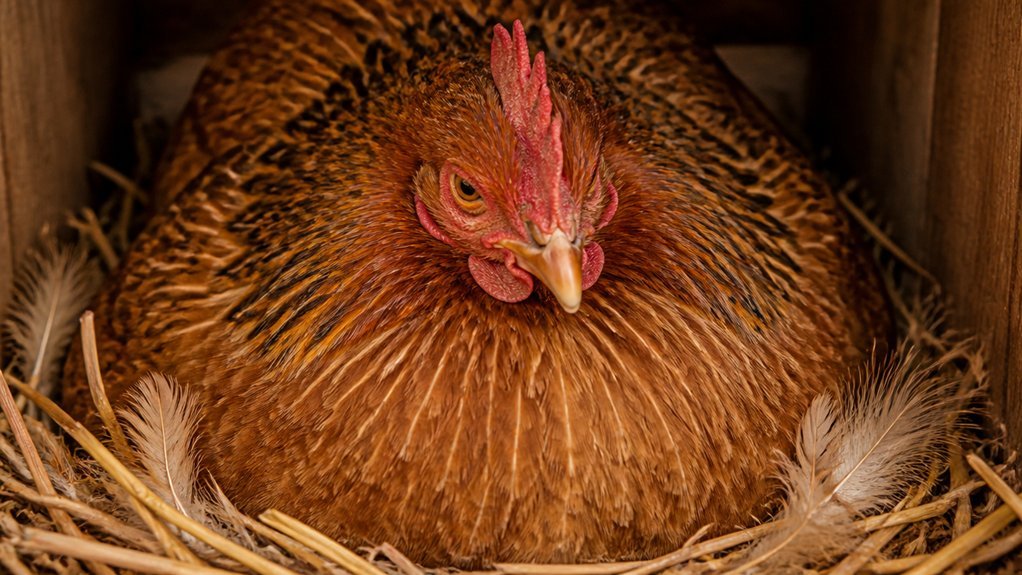
A broody hen is a hen that’s driven to sit on eggs and hatch them, even when those eggs aren’t fertile. You’ll notice this instinct when her body shifts from laying to nesting.
She protects a chosen spot, settles in for long stretches, and treats eggs like a priority. This behavior comes from hormones, not stubbornness, and it can appear in any hen breed.
Understanding this instinct helps you respond calmly and care for her needs without confusion. You’re seeing a natural reproductive cycle, not a problem.
Additionally, recognizing breed-specific behaviors can help you anticipate which hens are more prone to broodiness.
How to Tell a Hen Is Broody
You’ll often notice a broody hen’s nesting behavior change as she stays in the box longer and fusses with it more than usual. She may also become protective and aggressive when you reach near her, clucking sharply or pecking to guard the nest. Another clear sign is that she keeps sitting in one spot for long stretches, only getting up briefly, if at all. Additionally, broody hens often have a heavier, swollen appearance around their abdomen due to hormonal changes and nest-holding posture.
Nesting Behavior Changes
One of the clearest signs a hen is going broody is a sudden shift in how she uses the nest. You’ll notice she lingers there longer, returns often, and seems fixated on one spot. Instead of laying and leaving, she may sit in the box even when it’s empty. Her body language also changes: she tucks herself low, fluffs her feathers, and resistst moving when you approach.
A dust bath mix designed for healthy feathers and skin can support her overall comfort during this period.
- She picks one nest and guards her time there.
- She stays put after laying, sometimes for hours.
- She rearranges bedding or adds feathers to make the spot feel secure.
This nesting pattern tells you her instincts are shifting from egg laying to incubation, so watch for persistence over several days.
Protective Aggression Signs
Protective aggression often shows up when a hen gets broody, and she may start acting territorial around her nest. You might notice her puffing up, hissing, pecking, or lunging at you when you reach near her box.
She can clamp her wings tight, lower her head, and stare hard as if warning you to back off. If you move eggs or bedding, she may snap quickly and make repeated threat displays.
This behavior isn’t random; she’s trying to guard a space she now treats like her own. Stay calm and give her room, because pushing too hard can make her more defensive.
Watch how she reacts to your presence, and you’ll often spot broodiness before she settles into stronger mothering instincts. Disinfectants and cleaning products can help maintain a healthy nesting environment, reducing the risk of disease during broody periods.
Persistent Sitting Patterns
A broody hen will often plant herself in the nest and stay there far longer than usual, only popping up briefly to eat, drink, or relieve herself.
You’ll notice she ignores the flock’s movement and settles back in fast, as if the nest is her job.
Her persistence matters because it signals a hormonal shift, not simple laziness.
Watch for these patterns:
- She returns to the same spot after every short break.
- She flattens her body over the eggs and resists being moved.
- She spends most daylight hours sitting, even without eggs.
If you lift her out, she may hurry back and resume the same stance.
That stubborn repetition is one of the clearest signs you’re dealing with broodiness, not just a sleepy hen.
Additionally, her persistent sitting patterns are driven by hormonal changes that influence her behavior beyond just resting.
Broody Hen Behavior Signs
When a hen goes broody, you’ll usually notice her routine shift in clear, stubborn ways. She may puff up when you approach, cluck sharply, and hold her ground instead of moving off.
When a hen goes broody, she’ll often puff up, cluck sharply, and refuse to budge.
You’ll often see her become unusually protective, pecking at your hand or hissing when you try to check on her. Her appetite can drop, and she may spend long stretches motionless, focused and tense.
She might also stop joining the flock as much, choosing solitude and reacting irritably to disturbance. Her feathers can look fluffed and worn from constant settling.
These behavior changes tell you she’s not just resting; she’s strongly driven to incubate. Watch for this attitude shift, because it usually appears before anything else. Proper sizing and comfort are important to keep her comfortable during her brooding period.
Check Her Nesting Habits
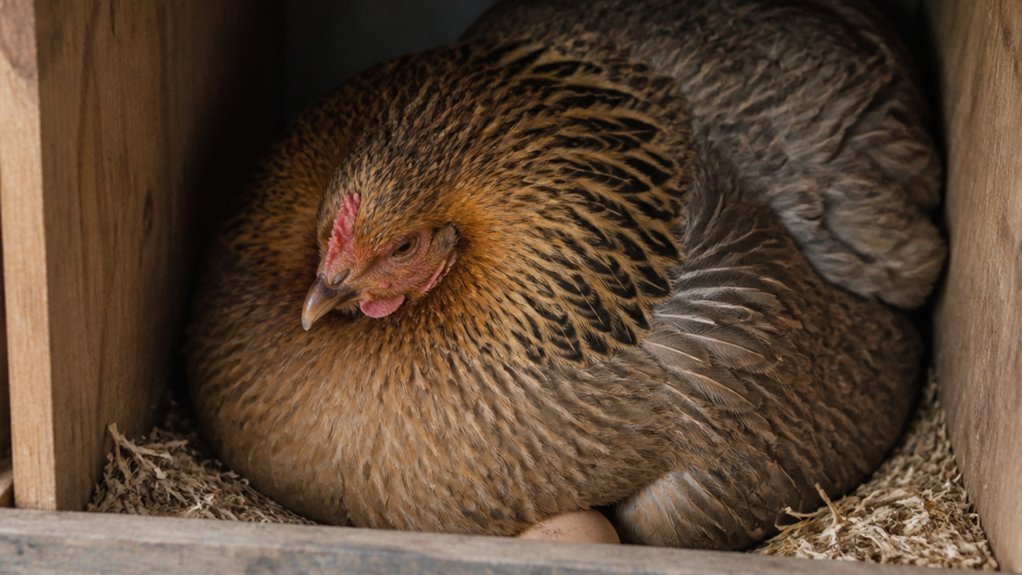
One of the clearest broody hen clues is how she treats the nest itself. You’ll notice she stays put for long stretches and won’t let the box sit empty for long. She may rearrange bedding, flatten it, or scratch it into a snug bowl that feels just right. Using nesting box features like angled roll-away trays and secure compartments can also encourage her to stay, indicating her intention to brood. Pay attention to these habits:
- She returns to the same spot repeatedly, even after you move her.
- She settles low in the nest and guards the space from other hens.
- She leaves only briefly to eat, drink, or dust bathe, then heads back.
You should also check whether she collects extra straw or feathers and tucks them under her body. That focused nesting pattern often means she’s preparing to sit, not just resting.
Notice the Clucking and Puffing
Listen for a broody hen’s change in voice and attitude. She may cluck low and insistently when you approach her nest, sounding more protective than usual. Instead of her normal chatter, you’ll hear short, tight calls that seem to warn you away.
She might puff up her body, lower her head, and hold still while keeping her focus on the eggs beneath her. This combination of clucking and puffing shows she’s deeply settled into sitting mode.
You can also notice how she reacts to disturbance: she won’t wander off easily, and she may resume her spot quickly after a brief interruption. Monitoring these behaviors helps confirm her broodiness before other signs become clear.
Watch for Feather Plucking
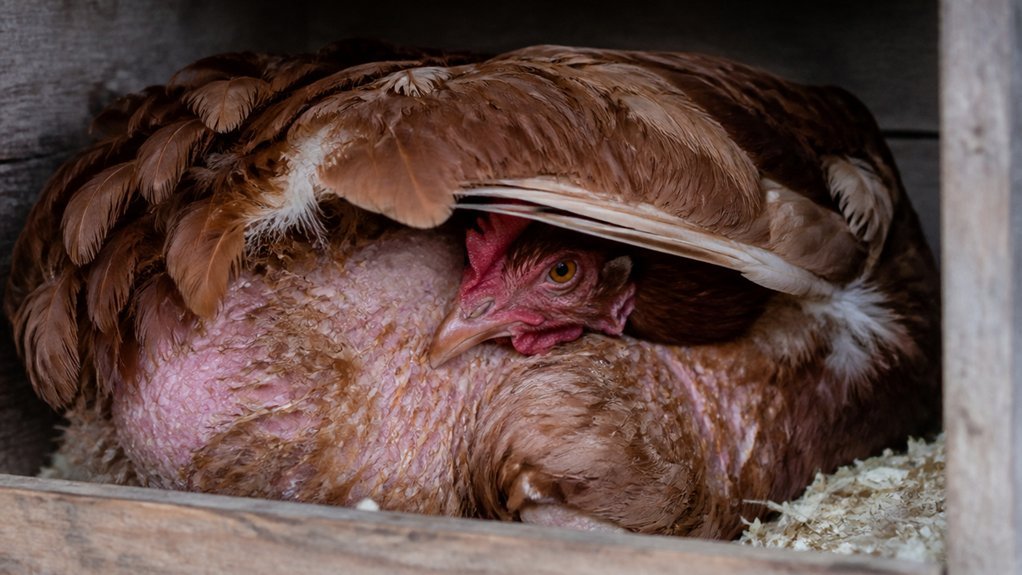
You might notice your hen plucking the feathers from her breast or nest area as broody behavior begins. This feather loss often leaves bare patches and helps her line the nest for eggs. A change in her bedding preferences can also signal her nesting instincts kicking in. Watch for these signs alongside her other broodiness cues to confirm what she’s doing.
Plucked Breast Feathers
A broody hen often pulls out feathers from her breast to line the nest, leaving a bare patch that’s easy to spot. You’ll usually see this area high on her chest, where the skin looks pink and exposed. That’s a strong clue she’s settling in for incubation, not just grooming herself.
Additionally, this behavior is often accompanied by resting for long periods, with the hen spending much of her day on the nest.
Check for these signs:
- A clean, rounded patch with missing down.
- Repeated nest-sitting, even when you approach.
- A tense, puffed posture when you lift her.
Don’t confuse this with ordinary molting or minor damage from pecking.
If the bare spot appears with clingy nest behavior and a refusal to leave eggs, you’re likely dealing with broodiness. Watch her closely, but don’t disturb her more than needed.
Nesting Feather Loss
Watch the nesting area for loose feathers, because a broody hen often plucks them to soften and insulate the nest. You may see a thin scatter of down mixed with straw, especially near her body-shaped hollow. This feather loss usually looks ragged, not neat, and it can leave a bare patch where she’s been sitting tightly.
| Clue | What You Notice | What It Means |
|---|---|---|
| Loose down | Feathers on the nest floor | She’s preparing insulation |
| Bare breast | Thinner feather cover | She’s plucking for warmth |
| Nest debris | Soft feathers mixed in bedding | She’s staying put often |
Check the nest daily, and compare it with nearby boxes. If the feather loss keeps growing, she’s likely investing more effort in the nest.
Broody Behavior Signs
Feather plucking is only one part of the picture, because a broody hen’s behavior changes in several obvious ways. You’ll often notice her staying glued to the nest, puffing up, and hissing when you reach in. She may stop roosting with the flock, eat less, and guard her eggs with fierce focus.
Watch for these signs:
- She clucks softly, then growls when disturbed.
- She flattens her body over the nest and resists moving.
- She pulls chest feathers to line the nest and keep eggs warm.
You might also see her leave only briefly for water or feed before racing back. If she keeps repeating this pattern, she’s likely broody, not just nesting.
Test Her Reaction to Eggs
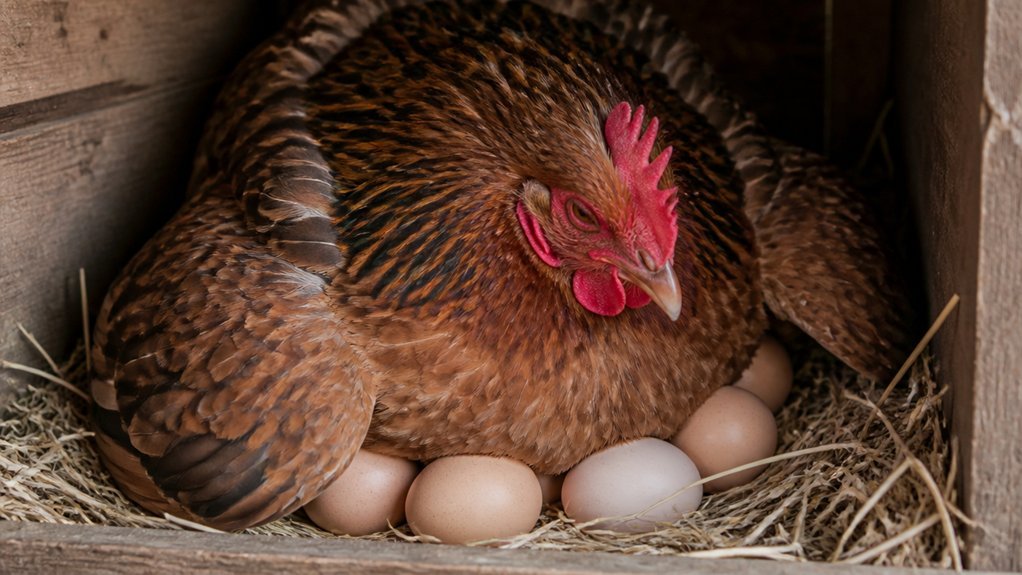
Place a few eggs, real or fake, in her nesting area and see how she responds. A broody hen usually settles over them right away, tucks them under her body, and stays put.
She may puff up, cluck softly, or peck at your hand if you reach in. If you remove the eggs, she’ll often try to pull them back beneath her.
Watch whether she treats the eggs like something worth guarding, not just nesting material. You can also slip in a cold egg and check if she warms it with her body.
Strong interest in the eggs, plus a refusal to leave the nest, is a clear sign that her mothering instinct has kicked in and she’s likely broody.
Broody Hen vs. Sick Hen
How do you tell a broody hen from a sick one? Watch her closely. A broody hen sits tight, puffs up, and protests when you reach under her, but she still looks alert and steady.
Watch her closely: a broody hen sits tight, puffs up, and protests, but still looks alert.
A sick hen usually seems weak, droopy, or unsteady, and she won’t guard a nest with the same focus.
- Check appetite: a broody hen may eat less, yet she’ll often drink and scratch when you remove her.
- Look at posture: broody hens flatten over eggs; sick hens hunch, tremble, or isolate themselves.
- Observe droppings and breathing: normal broody behavior stays clean and calm, while illness can bring diarrhea, wheezing, or a dirty vent.
If she seems lethargic, gets worse, or stops moving normally, treat her as sick.
What Triggers Broodiness in Hens
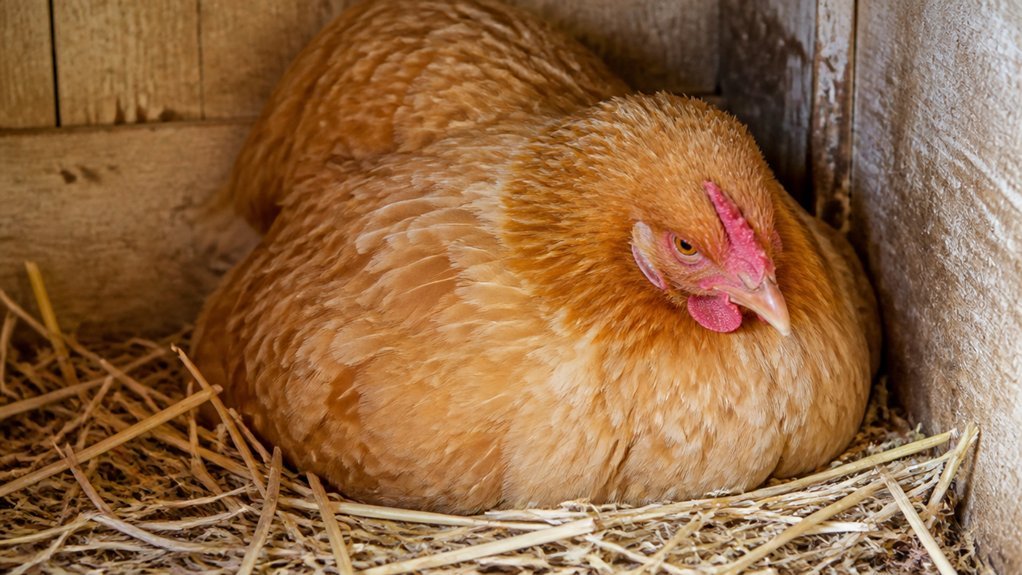
You’ll often notice broodiness when hormonal changes kick in and push a hen into mothering mode. Her nesting instincts can make her settle in place, gather eggs, and guard the nest more closely.
Environmental cues like longer daylight, a quiet coop, or a pile of eggs can also trigger the behavior.
Hormonal Changes
Hormonal shifts are what push a hen from normal laying behavior into broodiness, with increasing levels of prolactin playing the biggest role. When this hormone rises, you’ll notice she stops producing eggs and stays focused on incubation instead. Her body’s priority changes fast, so her comb may fade, and her energy often drops.
You can track the signs more clearly when you understand the internal changes:
- Prolactin suppresses egg production.
- Estrogen and other reproductive hormones dip.
- Her urge to sit tight strengthens.
These changes don’t happen by chance; they’re the result of a built-in reproductive switch. If you observe a hen acting unusually committed to staying put, hormonal changes are likely driving it. Recognizing this helps you respond quickly and handle her care properly.
Nesting Instincts
Along with hormone shifts, a hen’s nesting instinct can kick broodiness into gear. You’ll notice she starts treating her chosen nest like a prize, returning to it again and again. She may scratch, fluff, and settle into the spot with stubborn focus, as if she’s claimed it for the season.
That strong urge to protect a clutch can make her sit longer, peck less, and ignore normal distractions. You might also see her become possessive when you reach near her nest. This instinct doesn’t just guide egg laying; it pushes her toward sitting and guarding.
When nesting behavior intensifies, broodiness often follows soon after. Watch for a hen that won’t leave her nest for long and seems driven to stay put.
Environmental Cues
Environmental triggers can be just as important as a hen’s internal changes when broodiness sets in. If you want to spot the cause, watch her surroundings closely. Warm weather, longer daylight, and a quiet, secluded nest area can nudge her into sitting mode.
Stress can also matter; when your coop feels safe and stable, she’s more likely to settle and stay put.
- Egg availability: A full nest encourages lingering.
- Lighting: Extended light can signal breeding season.
- Comfort and privacy: Soft bedding and low disturbance reinforce the urge.
You’ll notice she spends more time in the nest, pecks less, and guards the area. When those cues stack up, broodiness often follows quickly.
How Long Broody Hens Sit
How long does a broody hen sit? Usually, you’ll see her stay on the nest for about 21 days, which matches the normal incubation period for chicken eggs.
She may leave briefly once or twice a day to eat, drink, and dust bathe, but she’ll return quickly. If you’re using a broody hen for hatching, keep in mind that some hens quit early, while others keep sitting a few days longer, especially if the nest still feels full to her.
You should check her progress daily without disturbing her too much. If she’s still committed after three weeks, she’s likely following a full brood cycle.
After the hatch, she may linger to care for chicks or lose interest soon after.
Signs She Will Stay Broody
A broody hen that will stay committed usually shows strong, consistent behavior: she settles in quickly when you approach, fluffs up and pecks if you disturb her, and returns to the nest right after brief breaks.
A committed broody hen settles fast, pecks at disturbance, and returns to the nest without hesitation.
You’ll also notice she guards the nest with stubborn focus and ignores distractions that normally get her moving. Her posture stays low and tense, and her eyes track you without leaving the eggs.
Watch for these clues:
- She spends most of the day seated in the same spot.
- She makes only short, reluctant trips for water or feed.
- She reacts strongly when you try to check the nest.
If these patterns hold for several days, she’s likely to stay broody.
What to Do With a Broody Hen
Once you’ve confirmed a hen is truly broody, decide whether to let her hatch eggs or break the cycle.
If you want chicks, give her fertile eggs, a quiet nest, fresh water, and easy access to feed. Mark the eggs so you can remove any extras she can’t cover. Check the nest briefly each day for broken eggs or pests, but don’t linger and stress her.
If you don’t want chicks, discourage the behavior by removing eggs promptly and limiting nesting triggers. Collect eggs often, block favorite nests, and keep her active with treats and foraging time. You can also use a wire-bottom cage for a short period to cool her hormones.
Watch her closely, because a broody hen may stop eating enough and lose weight.
When to Separate a Broody Hen
Sometimes, a broody hen needs to be separated if she’s harming her health, disrupting the flock, or refusing to leave the nest for long periods. You should act when she stops eating, drinking, or dust bathing, because dehydration and weight loss can follow fast.
You may also separate her if she pecks other hens, blocks nest boxes, or creates stress in the coop.
- Move her to a quiet, draft-free pen.
- Provide food, water, and a clean perch nearby.
- Check her daily and return her once she resumes normal behavior.
If she still won’t break the broodiness after a few days, you’ll need to keep limiting nesting access. Separation works best when you respond early and stay consistent.
Frequently Asked Questions
How Do I Tell if a Hen Is Broody or Just Nesting?
You’ll know she’s broody if she stays on the nest, growls, puffs up, and pecks when you reach in. A nesting hen usually gets up, eats, drinks, and returns normally without aggression.
Can a Broody Hen Lay Eggs at the Same Time?
No, usually you won’t see her lay normally while she’s broody. She’ll focus on sitting, puffing up, and guarding the nest instead. If you notice fresh eggs, another hen probably laid them there.
Do All Chicken Breeds Become Broody?
No, you won’t see broodiness in every breed. You’ll usually notice it more in Silkies, Cochins, and Orpingtons, while many production breeds rarely go broody. Your bird’s instincts, age, and environment all matter.
Will a Broody Hen Eat and Drink Normally?
Yes, she’ll usually eat and drink less often, but you’ll often see her leave the nest briefly to do both. You should check that she’s still staying hydrated and eating enough each day.
Can Broodiness Return After a Hen Stops?
Yes, broodiness can return after she stops, and you’ll often notice it again in the same hen. You can reduce chances by removing eggs, discouraging nesting, and keeping her busy with regular foraging.
In Summary
Now that you know how to identify a broody hen quickly, you can act fast and decide what’s best for your flock. Watch for nesting changes, nonstop sitting, clucking, puffing, and stubborn behavior that lasts for days. If she’s truly broody, you can either let her hatch eggs or gently break the cycle. The sooner you notice the signs, the easier it is to manage her and keep your hens healthy and productive.